Report
The Hidden Cost of India's Ethanol Fuel: Strong Rupee, Weak Engines
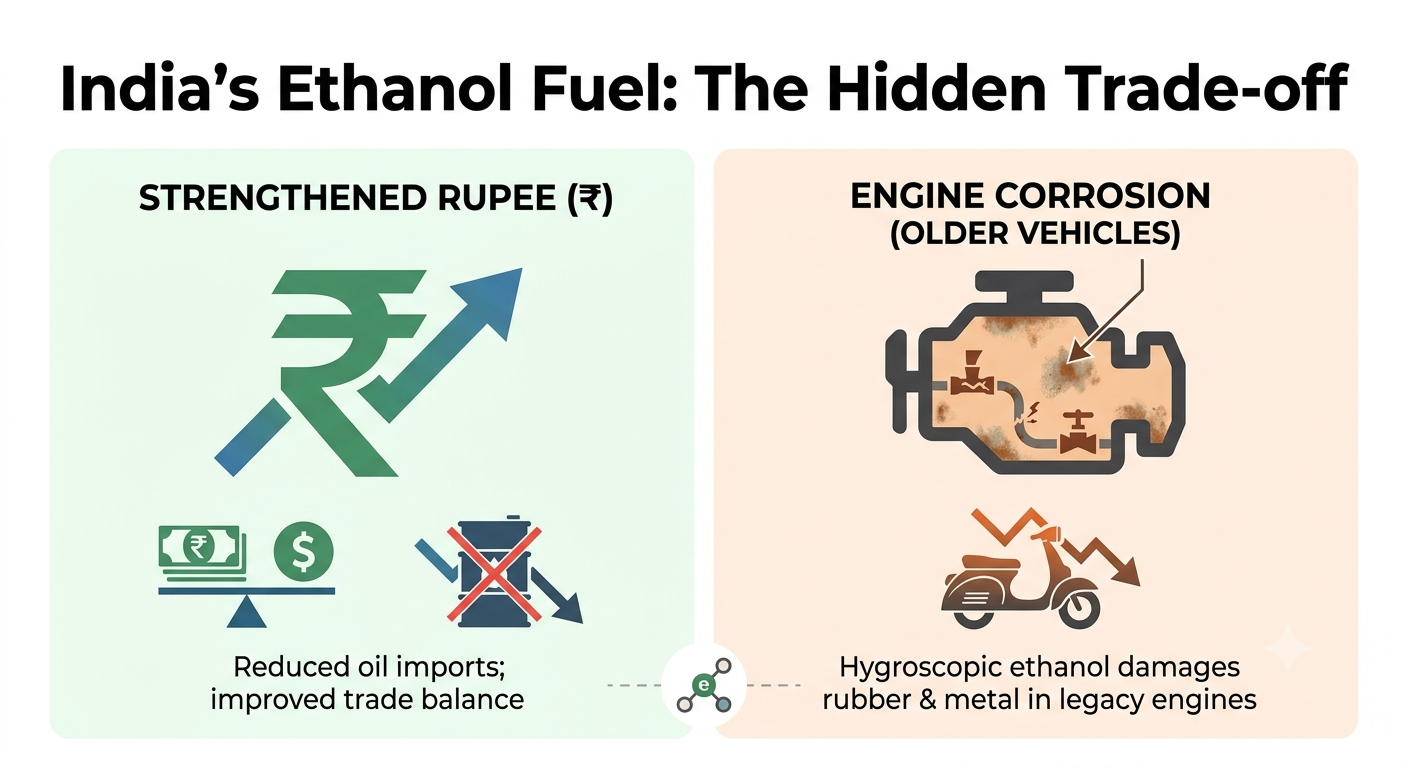
India has now reached its 20% ethanol blending target for petrol, a big jump from just 1.5% back in 2014. Since India imports most of its crude oil, blending ethanol into petrol means the country needs to buy less oil from other nations. Between 2014 and 2026, this has saved India around ₹1.7 lakh crore (about $19.3 billion) in foreign currency, reduced crude oil imports by 289 lakh metric tonnes, and cut roughly 869 lakh metric tonnes of carbon emissions. It has also channeled about ₹1.5 lakh crore directly to farmers and rural distilleries who supply the sugarcane and grain used to make ethanol. This solved a long-standing problem too - India used to grow more sugar than it could sell, crashing prices and leaving farmers unpaid for months. Turning surplus sugarcane into ethanol gave farmers a stable, guaranteed buyer instead of unpredictable sugar markets.
This has a real effect on the Rupee's strength. Because India needs fewer dollars to import oil, there is less pressure pushing the currency down. Without ethanol blending, analysts estimate the Rupee could be weaker by about ₹2.50 to ₹4, and possibly by ₹5 or more during a global oil crisis, pushing it from today's roughly ₹95.34 per dollar toward ₹100 or higher.
This matters to ordinary people because oil is always bought in US dollars. A weaker Rupee means every barrel of oil costs more in Rupee terms, even if the dollar price hasn't changed. That extra cost eventually reaches common people through higher fuel prices at the pump, higher auto-rickshaw, cab, and bus fares, and even pricier groceries, since most fruits, vegetables, and daily goods travel across India in diesel trucks.
However, there is a downside at the vehicle level. Ethanol has two troublesome chemical properties: it absorbs moisture from the air, which can lead to water buildup, rust, and damaged fuel pumps, and it acts as a strong solvent that wears down old rubber hoses and plastic parts while loosening old grime inside the tank, which then clogs filters and injectors. Vehicles made before April 2023, including older BS4 and early BS6 models, were built to handle only E5 or E10 fuel, so they face moderate to high risk of long-term wear with E20 fuel. Vehicles made after April 2023, however, were redesigned with ethanol-resistant materials like Viton rubber seals, stainless or anodized fuel lines, and upgraded injectors, making them fully safe to use with E20.
For owners of older vehicles, a few precautions can help protect the engine. It helps to avoid leaving the tank half-empty for long stretches, since the empty space invites moisture; keeping the tank fairly full or using a fuel stabilizer reduces this risk. Fuel filters should be replaced a little earlier than the usual schedule, since ethanol flushes out old grime faster than expected. Fuel hoses should also be checked regularly during servicing for any cracking, swelling, or hardening.
Overall, this represents a classic trade-off between the big picture and the small picture. At the national level, ethanol blending strengthens the economy, protects the Rupee, and supports farmers with steady income. At the personal level, though, someone driving an older car or two-wheeler may end up paying more for maintenance, dealing with worn fuel pumps or damaged hoses, even as the country as a whole benefits financially.