Report
Supreme Court Strikes Down Trump's Bid to End Birthright Citizenship
On June 30, 2026, the US Supreme Court delivered one of the most significant rulings in American history, striking down President Donald Trump's attempt to end automatic citizenship for babies born on American soil. In a case called Trump v. Barbara, the Court ruled that the Constitution's guarantee of birthright citizenship applies to nearly everyone born in the United States, regardless of their parents' immigration status. In simple words: no president, not even one as powerful as Trump, can rewrite the Constitution through an executive order alone.
The story began back in January 2025, when Trump signed Executive Order 14,160, just after taking office for his second term. The order tried to deny automatic citizenship to children born in the US if neither parent was a citizen or green card holder - a move that would have affected children of undocumented immigrants and even children of people legally in the US on temporary visas, such as students and skilled workers. Immigration rights groups, led by the ACLU, immediately took the fight to court on behalf of thousands of affected families. Every court that looked at the order blocked it, and the case eventually reached the Supreme Court, renamed Trump v. Barbara after arguments were heard in April 2026.
The nine judges were divided, but the outcome was clear. Chief Justice John Roberts, joined by Justices Sotomayor, Kagan, Barrett, and Jackson, ruled that the 14th Amendment's words are unambiguous - anyone born on US soil and subject to its laws is a citizen at birth, no matter their parents' legal status. Justice Kavanaugh agreed the order should fall but based his opinion on ordinary federal law rather than the Constitution itself, making the vote 6-3 in outcome but closer to 5-4 specifically on the constitutional question. Justices Thomas, Alito, and Gorsuch dissented, arguing the 14th Amendment was never meant to cover children of undocumented or temporary immigrants - though even Gorsuch admitted he had doubts about denying citizenship to children of undocumented parents who intend to live in America permanently.
Trump's central argument was that children of undocumented or temporary immigrants are not truly "subject to the jurisdiction" of the United States, a key phrase in the Constitution's citizenship clause. The Court flatly rejected this, leaning heavily on a landmark 1898 case, United States v. Wong Kim Ark, which had already established that birth on American soil grants citizenship with only a few narrow exceptions - children of foreign diplomats, children of invading armies, births on foreign ships, and children born in a couple of small US territories. Ordinary immigrant families do not fall under any of these exceptions, and the Court made clear that 128 years of legal precedent could not simply be brushed aside by executive order.
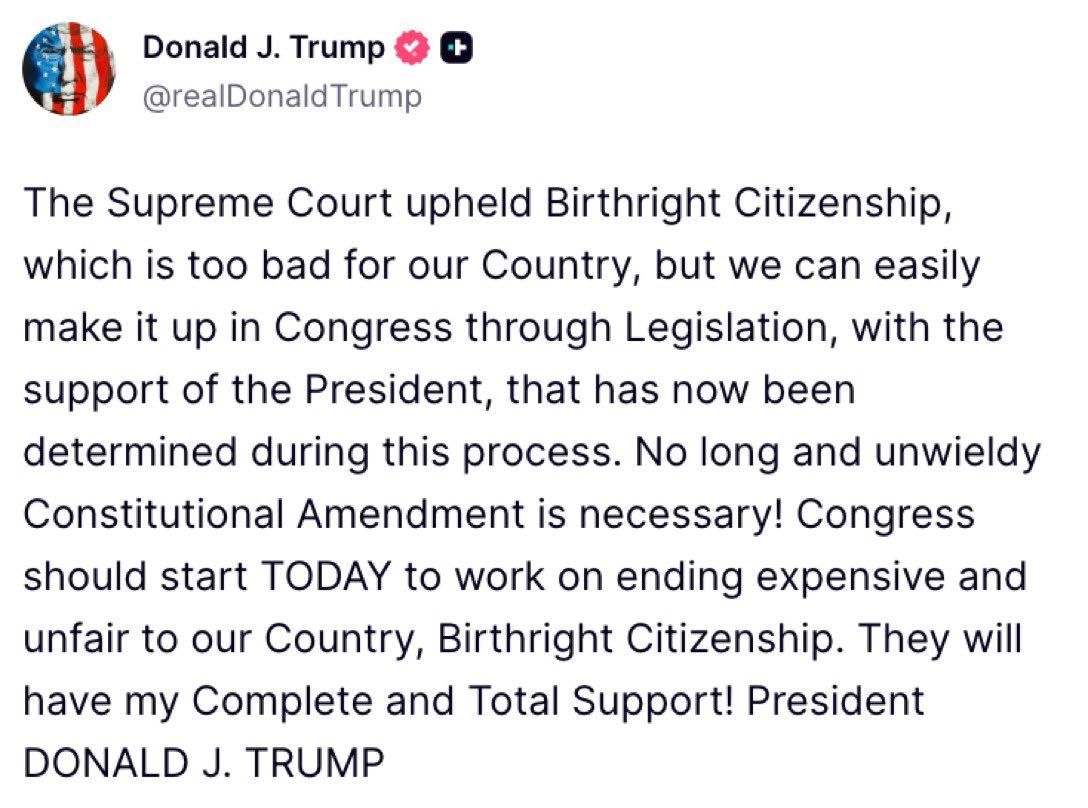
Trump reacted on social media, calling the ruling "too bad" for the country but suggesting Congress could still act through legislation. In reality, this is far easier said than done - because the Court ruled that birthright citizenship is a constitutional guarantee, not just a policy, undoing it would require a formal constitutional amendment: two-thirds approval in both houses of Congress plus ratification by 38 of the 50 states. This is an extraordinarily high bar that has been cleared only a handful of times in over two centuries of American history, making any real change to birthright citizenship highly unlikely for the foreseeable future.
For the large Indian community in America, many of whom live for years or even decades on temporary visas like H-1B while waiting in painfully long green card queues, this ruling brings enormous relief. Had Trump's order survived, babies born in the US to Indian parents without a green card could have been denied automatic citizenship. With the Supreme Court's decision, that danger has been erased - any child born on US soil to Indian parents, regardless of visa status, remains an automatic American citizen, just as it has been for well over a century. Legal experts are already calling this one of the most important Supreme Court rulings of the decade, and a powerful reminder that in America, the Constitution - not the president - has the final word.