Report
Why a Small Karnataka Company's Case Could Shake Up India's Fuel Supply
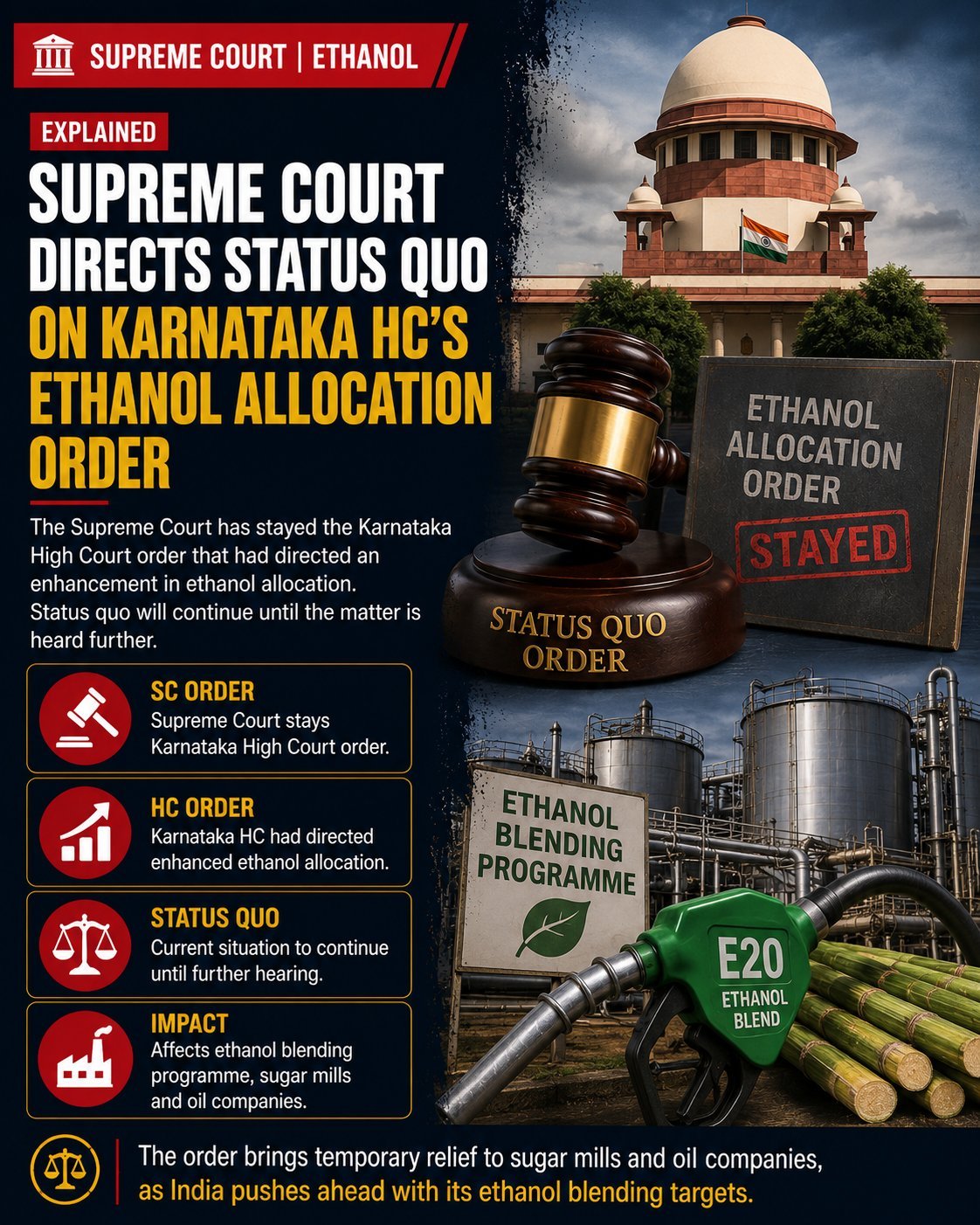
To understand this properly, think of it like a school where the teacher (the government) had already decided how many sweets (ethanol) each student (each company) gets for the year. But one student went to a different authority and complained that they got fewer sweets than they deserved - and that authority told the teacher to reconsider. Now the teacher is worried that if this one student's complaint is entertained, every other student will also demand a recount, and the whole sweet-distribution system will collapse into chaos. That, in simple terms, is exactly what happened here.
There is a small ethanol-making company in Karnataka called VINP Distilleries. This company built its own ethanol plant with the capacity to produce about 9.9 crore litres of ethanol every year. But when the government finalised who gets to supply how much ethanol for 2025-26, VINP was allocated only about 3.9 crore litres - far less than what its plant could actually produce. VINP felt this was unfair, especially because it had a long-term agreement with the big oil companies (BPCL, IOCL, HPCL) that was supposed to give dedicated ethanol plants their preferential treatment.
So VINP went to the Karnataka High Court. On 16 June 2026, the High Court agreed that VINP's complaint had merit and ordered the three big oil companies to reconsider and decide on VINP's request for a higher allocation.
This is where BPCL got worried and rushed to the Supreme Court. BPCL's argument was: the entire allocation for this year - covering 378 different suppliers and about 1,050 crore litres of ethanol - was already finalised in October 2025, months ago. Supply has already started; nearly 680 crore litres have already been delivered. If the file is reopened now just because one company is unhappy, every other supplier who feels shortchanged will also go to court, and the whole allocation will need to be redone over and over. That, BPCL argued, would throw the entire ethanol supply system into disorder - and this ethanol is what goes into petrol pumps across the entire country. BPCL's lawyer also pointed out that similar complaints from other companies were already pending in different High Courts across India, which made the risk of confusion even bigger, since different courts could pass different, conflicting orders on the same national policy.
The Supreme Court bench, hearing this on 30 June 2026, agreed that this needed urgent attention. It did not cancel the Karnataka High Court's order permanently, but it put things on hold - meaning no changes will be made to anyone's ethanol allocation until the Supreme Court hears the matter properly and decides. In legal language this is called "status quo," which simply means: freeze everything exactly as it is right now, don't let anyone's allocation increase or decrease, until the matter is sorted out.
During this hearing, the government's top lawyer made an interesting admission - he told the court that the entire 20% ethanol blending programme is still an "ongoing experiment" and that its real, full impact will only become clear after another year of data. This is a fairly honest admission: even though the government talks confidently about E20 in public, in court it acknowledged that this massive nationwide programme is still being tested and fine-tuned, not something that is fully settled science yet.
Why This Small Dispute Matters to the Whole Country
You might wonder why one small company's complaint in Karnataka should become a Supreme Court matter that affects the entire nation. The answer is exactly what makes this story important: ethanol blending has grown into such a massive, tightly interconnected system that even one local dispute can threaten to disturb the whole chain.
If VINP is allowed to get a higher allocation through a court order after contracts were already signed, then all the other 377 suppliers, and possibly hundreds of other ethanol producers across India who also feel they got less than they deserved, could rush to different courts demanding the same treatment. This is exactly why the Attorney General asked the Supreme Court to combine all similar pending cases from different states into one, so a single, consistent decision could be made for the entire country instead of confusing, conflicting orders from different High Courts.
This case is also a reminder that the government considers the ethanol supply chain very time-sensitive. The Attorney General told the court that a decision is needed before October 2026, because that's when fresh ethanol supply contracts for the next year are due to be finalised. So this isn't just a slow-moving legal matter; it directly affects planning for next year's fuel supply too.
In short, what looks like a small dispute between one distillery and a few oil companies is really a test case for how India manages a massive, high-stakes national programme - one that now involves hundreds of suppliers, over a thousand crore litres of fuel, and directly affects what goes into the petrol tank of nearly every vehicle in the country.