Report
India is shockingly resetting voter lists back to 2002 after 24 years of successful elections.
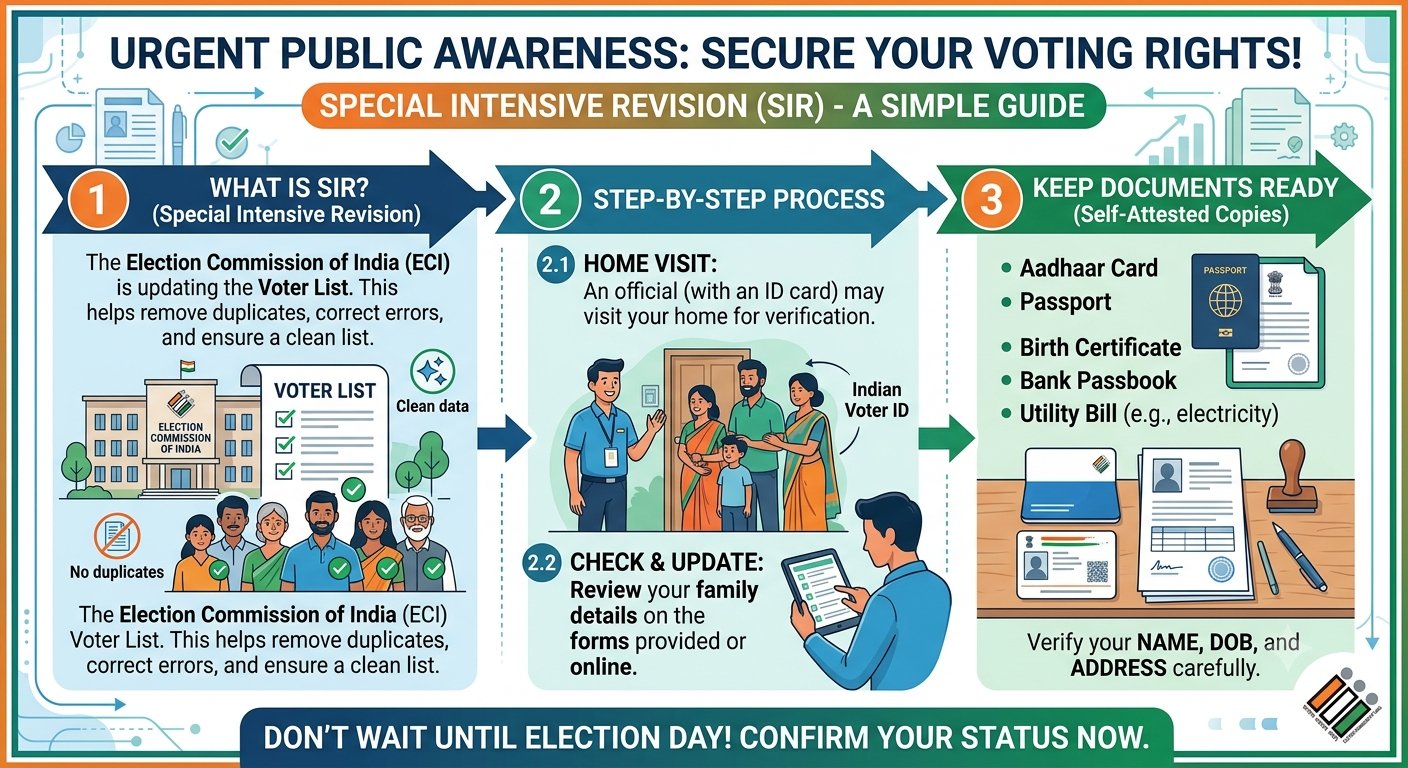
Every democracy relies on a clean and accurate list of citizens who are eligible to vote, which we call the electoral roll in India. Recently, the Election Commission of India launched a massive, nationwide clean-up called the Special Intensive Revision, or SIR. On paper, this sounds like a great idea because it aims to remove duplicate entries, delete the names of people who have passed away, and clear out voters who have permanently moved away. However, the way this massive task is being handled on the ground is turning into a chaotic headache for millions of ordinary citizens, especially the poor, the elderly, and migrant workers.
The most interesting and ironic part of this entire cleanup is that the government is matching current records against data from 2002. What makes this truly surprising is that over the last twenty-four years, India has successfully conducted and won multiple historic national General Elections - including the mega-elections of 2004, 2009, 2014, 2019, and 2024 - alongside dozens of state assembly polls. All of our democratic governments were formed, leaders were chosen, and major political mandates were won using this exact same voter list. The very database that successfully powered the world’s largest democracy for nearly a quarter of a century is now suddenly being treated by the system as deeply flawed and unreliable.
The government's argument is that even though these past elections went smoothly, small typing errors, name variations, and unrecorded deaths slowly piled up over two decades of quick digital updates. By forcing a hard factory reset back to the 2002 physical baseline, the system aims to clear out this hidden clutter and weed out "ghost voters." However, this creates a bizarre situation for the common man. Citizens who have been actively casting their ballots for decades are suddenly being viewed with suspicion, forcing families to hunt down scattered, poorly digitised ancestral documents from twenty-four years ago just to prove they have the right to stay on the list.
The scale of this cleaning drive is truly massive and has moved at a breakneck speed across the country, carrying a heavy human cost. In just a few months, crores of names have been completely wiped off the registers across major states like Bihar, Uttar Pradesh, and West Bengal. This blunt method hits the poorest citizens, daily wage labourers, and homeless people the hardest because they are the least likely to possess perfect historical paperwork or have the resources to travel to government offices for formal appeal hearings. When a nationwide database reset is rushed under rigid deadlines, the entire burden of proof falls onto ordinary people, meaning a genuine voter might only discover they have been deleted on election day when it is already too late.
To check these records, the system relies entirely on a single local government worker known as the Booth Level Officer, or BLO. In theory, a physical door-knock by a BLO is a great safeguard because an online document cannot prove if a person is still alive, but a human can. In reality, these officers are heavily overworked, responsible for thousands of voters, and facing unrealistic targets. Because they cannot physically reach every home in time, citizens are often forced to travel to crowded local schools to submit papers anyway. Furthermore, a simple spelling mismatch between a modern identity card and a decades-old paper archive can instantly flag a voter as an anomaly, trapping the citizen in endless red tape.
This situation brings to light a strange contradiction for a country known globally as an information technology giant. Indian software companies build systems that run international airlines and complex tax departments, yet a local municipal death certificate cannot automatically update the central voter list. This database gap exists because vital statistics like births and deaths are managed by individual state governments, while the electoral roll is managed by an independent central body. Because these systems live in separate digital silos, they do not talk to each other in real-time, meaning an exhausting manual human check is still required to bridge the gap.
Even if these computer databases were connected today, automatic matching is a nightmare due to inconsistent spelling. The exact same person can be registered with partial initials in one municipal document and with their full ancestral name in another database. A simple computer program trying to match these different formats could easily make an error and accidentally delete a living citizen from the voter list. Because stripping a person of their voting right causes massive public outcry, the government prefers to trust slow, manual, paper-chasing methods rather than letting an automated digital database handle the deletions.
In contrast, developed nations like the United States or the United Kingdom manage identity records without needing door-to-door physical visits for voter registries. Instead, they rely strictly on a single, lifelong unique number given to every citizen, such as a Social Security Number or a National Insurance number. When a person passes away, that specific number is flagged once in a central system, and every other connected database updates itself automatically. A shared name or a spelling variation means nothing to their computers because only the unique number matters, which completely prevents identity theft and protects genuine voters from accidental deletion.
India is actively working toward a similar automated solution through modern legislative reforms that aim to create a unified national database linking births and deaths with unique digital identity authentication numbers. However, the pain citizens are feeling right now is because the system is trying to force twenty-four years of messy, unverified historical data into this new digital framework all at once. To ensure this cleanup succeeds without hurting the common man, the government must slow down the process, prioritise linking birth and death registries digitally before placing the burden of paperwork on citizens, and offer simplified verification paths for vulnerable groups. Ultimately, a voter list should be treated as a long-term infrastructure project rather than a rushed, one-time drive that risks leaving eligible citizens behind.